
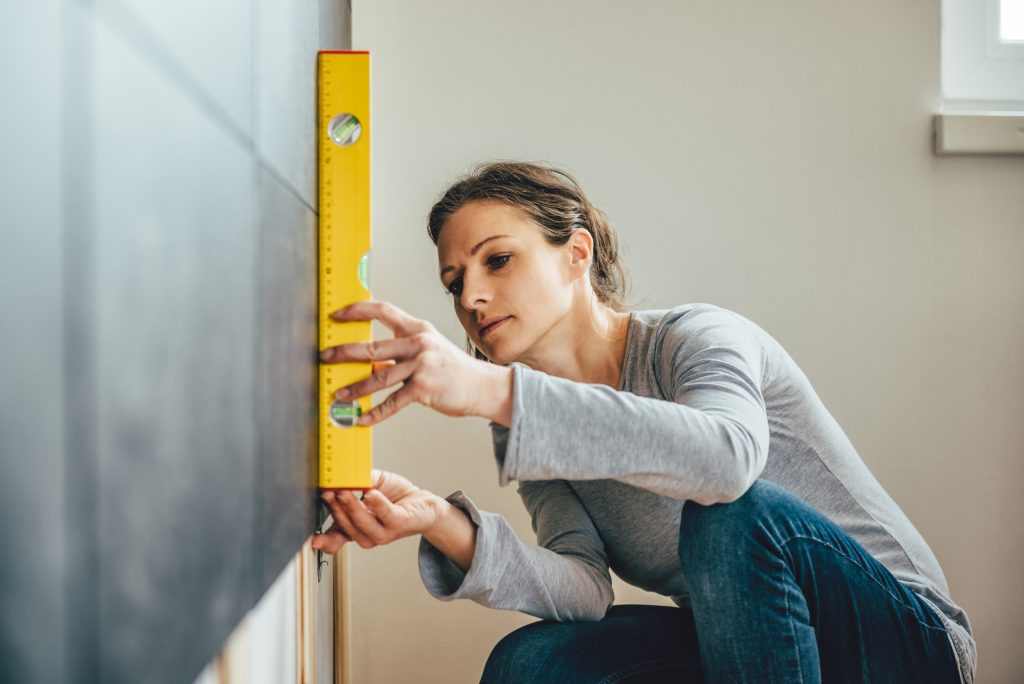
It doesn’t matter if you’re building a cabinet, mounting curtain rods, working on a deck, or doing any other project; a level gives you confidence that everything is in line.
If you’ve ever hung a picture frame and stepped back to see it visibly slanting to one side, you know how important it is to get things straight. That’s where a level comes in. This simple tool helps ensure your surfaces and lines are even, whether you’re working horizontally, vertically, or at an angle.
For beginner DIYers, learning to use a level correctly can make a noticeable difference in the quality of your home projects.
How a Level Works
Levels come in different sizes and styles, but they all work using the same principle: a liquid-filled vial with a bubble in it. When the bubble sits between the marked lines on the vial, the surface is straight.
Levels can tell you if something is perfectly horizontal, which means that the surface is level, or perfectly vertical, which means that the surface is plumb. It all depends on how you hold the tool. It doesn’t matter if you’re building a cabinet, mounting curtain rods, working on a deck, or doing any other project; a level gives you confidence that everything is in line.
Using a Level Correctly
Using a level isn’t difficult, but it does take some care. Always place the level on a clean, flat surface. Even a bit of dust or a small screw head can throw off your reading. If you’re marking a line, hold the level steady and make light pencil marks where needed.
For longer spans, use a larger level or a straightedge in combination with a smaller one to ensure consistency. And remember to check the level in more than one direction; something can be level from side to side but off front to back.
Checking for Plumb and Alignment
For vertical alignment, use the level’s side edge and check the bubble to make sure what you’re installing stands straight. This is especially helpful when lining up furniture, cabinet edges, or structural pieces like posts or beams.
A small torpedo level is handy for tight spaces, while a longer level is better suited for larger jobs like checking countertops or floor installations.
When To Call a Handyman
While using a level is straightforward, more complex tasks such as framing walls, cutting drywall, or aligning large fixtures can get complicated quickly. For those projects, it’s often worth calling in a professional.
At One Man And A Toolbox, our experienced handymen are trained to handle tricky installations where precision really matters. You might be able to handle a shelf or two, but if you’re working with uneven surfaces, large builds, or anything that needs to be squared to code, having help is a smart move.
A Straight Finish Matters
Getting things level isn’t just about looks. It’s about safety, durability, and function. A slightly off cabinet can swing open on its own, and a tilted table or grill station can shift or tip over time.
Taking the time to measure and adjust with a level gives your project the best chance of holding up and looking good. And your projects deserve to look great! If you’re worried that your DIY might turn into “D-I-why?”, we can help. Contact One Man and a Toolbox for help with any of your home improvement projects.